
 |
 |
| ActiveWin | Anonymous | Create a User | Reviews | News | Forums | Advertise | VBA in Excel | Users Online: 0 |
|
|
|
|
|
User Controls |
|
New User |
|
Login |
|
Edit/View My Profile |
|
|
|
|
|
|
|
Active Network |
|
ActiveMac |
|
ActiveWin |
|
ActiveXbox |
|
DirectX |
|
Downloads |
|
FAQs |
|
Interviews |
|
MS Games & Hardware |
|
Reviews |
|
Rocky Bytes |
|
Support Center |
|
TopTechTips |
|
Windows 2000 |
|
Windows Me |
|
Windows Server 2003 |
|
Windows Vista |
|
Windows XP |
|
|
|
|
|
|
|
News Centers |
|
Windows/Microsoft |
|
Apple/Mac |
|
Xbox/Xbox 360 |
|
News Search |
|
XML/RSS Newsfeeds |
|
Pocket PC Site |
|
|
|
|
|
|
|
FAQ's |
|
Windows Vista |
|
Windows 98/98 SE |
|
Windows 2000 |
|
Windows Me |
|
Windows Server 2003 |
|
Windows XP |
|
Windows 7 |
|
Windows 8 |
|
Internet Explorer 6 |
|
Internet Explorer 5 |
|
Xbox 360 |
|
Xbox |
|
DirectX |
|
DVD's |
|
|
|
|
|
|
|
Latest Reviews |
|
Xbox/Games |
|
Fable 2 |
|
|
|
Applications |
|
Windows Server 2008 R2 |
|
Windows 7 |
|
Adobe CS5 Master Collection |
|
|
|
Hardware |
|
Microsoft Express Mouse |
|
|
|
|
|
|
|
Latest Interviews |
|
Mike Swanson |
|
|
|
|
|
|
|
Site News/Info |
|
About This Site |
|
Advertise |
|
Affiliates |
|
Contact Us |
|
Default Home Page |
|
Link To Us |




 |
Windows XP Tablet PC Edition reviewed @ Supersite For Windows | |
|
||
| Time: 18:37 EST/23:37 GMT | News Source: WinInformant | Posted By: Byron Hinson | ||
|
Since the dawn of the PC era, various companies have undertaken various initiatives to move computing away from keyboard and mouse-based input and towards the more natural interfaces of pen and voice. And while voice computing has seen some limited success, pen computing is set to explode with the introduction of Microsoft's Tablet PC platform, driven by a new Windows XP version logically named Windows XP Tablet PC Edition. |
||

|
Read Only Comments Return to News |
Displaying Comments 1 through 18 of 18 |
This is an archived static copy of ActiveWin.com. |
| #1 By 3339 (65.198.47.10) at Tuesday, June 25, 2002 06:54:07 PM |
|
"Microsoft's handwriting reco doesn't learn by doing, either, so it won't get any better at mastering your particular handwriting over time. As it is, you can change your handwriting for the recognition engine if you like--just don't expect it to change for you." D. Coursey
v. "But this technology is clearly better than its ever been, and it will learn as you go, without requiring you to sit through a formal teaching session, as you must for speech recognition." P. Thurrott So who's right and who's wrong? Generally David's a bit weaker on the facts, but P.T. seems to be covering for MS here. This seems like something David would have gotten down firm from the MS tech's at his lab sessions. Any theories? Firm answers? |
| #2 By 3339 (65.198.47.10) at Tuesday, June 25, 2002 07:46:12 PM |
| Considering it only recognizes cursive--for all the jokes the Newton could recognize transitions from cursive to standard writing seamlessly--and that Paul didn't show any drawing-to-character mapping input utilities, I'd say he's lying. Of course, P.T.'s email (or rather duke or Penton publishing's) is down today or disabled, so I can't get him to answer to his claims. |
| #3 By 2459 (24.206.97.178) at Tuesday, June 25, 2002 08:16:10 PM |
|
Actually, I was just about to post about Coursey's statement about TabletPC only recognizing cursive. I'm pretty sure this is incorrect because I have seen in Microsoft's own demos a TabletPC recognizing cursive, block-style text, and a mix of the two.
It even recognized text within diagrams and could convert the handwritten text within the diagrams into typed text while leaving the diagrams alone. Also, according to CNET, Microsoft in 1999, acquired handwriting technology from Pen and Internet. MSR probably used this as a base for their current technology. An earlier version of this technology (8 years earlier) was the handwriting tech that Apple licensed for its Newton. I have to question Coursey's credibility on the TabletPC. Maybe his handwriting is the real problem since he, himself, describes it as "legendarily messy". A quote from an MSR article: "Even better, the handwriting recognition in Tablet PC can take your handwriting (as long as your writing doesn't resemble chicken scratches) and transform it into digital text. You can then search your handwritten notes." It also supports Asian languages, German, and others. This post was edited by n4cer on Tuesday, June 25, 2002 at 20:21. |
| #4 By 3339 (65.198.47.10) at Tuesday, June 25, 2002 08:28:17 PM |
|
Yeah, we'll see how this plays out, enforcer. As I said, I sent messages off to both, but my messages to PT go bounced. I think we'll be able to get some clarification by playing the two off each other. I didn't initially bring up the cursive thing, because P.T. basically concedes this: "It works well, especially if you print." All of his and many other samples I have seen are all cursive, with the typical male characteristic of injecting standard writing as caps and within words... I'm leaning towards believing that the MS Ink only picks these letters up with precision and that it doesn't perform well if all letters are written in long form. But clearly Coursey is a bit wrong about this issue.
This still doesn't answer the learning capability which you'd expect to be highlighted by P.T. I mean, if it learns as you go, there should also be a utility to program words you know it has trouble recognizing and storing them--the closest thing in P.T.'s review is basically text recognition with a Spell Checker saying: is this right or wrong. That doesn't look to me like a "learning" system. But I'm not claiming to know; I just think it's one of the more important points and should be cleared up since there's clearly a discrepancy in how people are reporting this. This post was edited by sodajerk on Tuesday, June 25, 2002 at 21:06. |
| #5 By 2459 (24.206.97.178) at Tuesday, June 25, 2002 08:44:44 PM |
|
This doesn't answer our question, but does offer some insight into how the recognition works.
http://research.microsoft.com/features/tablet.asp |
| #6 By 3339 (65.198.47.10) at Tuesday, June 25, 2002 08:57:54 PM |
|
Actually, I'm more confused. In fact, I'm starting to think "ink" is a way to dodge the inability to push text recognition from handwriting past 90% and closer to 98%.
But my confusion... "ink" isn't just stored as a graphic but as a recognized-text-meta-format where it exists both as graphic and as text (that is--it stores word breaks and words and spelling and can be manipulated and parsed)? Confused? Coursey said files would be sent as .tiff, but that doesn't store this "ink" capability. Ms hasn't said anything about the Mac so if there is some meta format for "Ink" has Microsoft now broken Mac Office file compatibility? P.T. says that all apps will support this--which confused me because then he mentions Office compatibility; I thought all apps were compatible? But if it's storing this data in some weird meta-graphic/meta-text format won't that require a whole new format for every frmat for any app? How big does this make files--to be storing notes as graphic--sure they are b/w, but they are hi-rez anti-aliased, right? In fact, it does support colors--so we could be talking quite the increase in file size... Particularly if "ink" maintains a weird duality. God, these people are reporters? They've tested this stuff? These things are the first thing that come to my mind--why didn't they answer these questions! This post was edited by sodajerk on Tuesday, June 25, 2002 at 21:07. |
| #8 By 2459 (24.206.97.178) at Tuesday, June 25, 2002 09:58:04 PM |
|
THe MSR article basically says that they implemented a hybrid between stroke recognition and conventional English handwriting recognition.
They store the ink as an image for portability and for compatability with apps that don't natively support ink. It doesn't store pixel data (to save space). Also, similar strokes are stored as only one stroke but with a reference to the various locations that stroke appears in. The meta data they describe is when you write in you own handwriting, but store simply that (your handwritten text) instead or having your text recognized and changed to typed text. In the background (not on screen), you handwriting is still recognized and stored with/in the file you save so that when you do a document search (or text within document search), the computer will look for the embedded text strings within the handwritten document just as it would a regular document to find what you are looking for. On Windows, the ink is a data type. The ink can be stored as an enhanced GIF for persistance and maintained editability on other platforms. You can check here for a sample Chat client that explains it better. http://www.tabletpcdeveloper.com/content/whitepapers/inkchat/#SendingInk . ----------------------------------------------- About the Newton: You should check www.penandinternet.com The CNET video there, as well as their parent company, Parascript. I'll take your word on the 2.0 implementation. One thing we agree upon is Soviet involvment: Alexander Pashintsev - Vice President Alexander Pashintsev has over eighteen years of experience in research and development and over nine years of experience in advanced project management in the software technology industry. He joined ParaGraph International in 1991 as a project leader and was subsequently promoted to project manager and program manager of recognition technologies. Mr. Pashintsev led the integration of the industry's first cursive handwriting recognition system with various pen-enabled operating systems such as Newton OS, Windows CE and Windows. Mr. Pashintsev holds an MS degree from the Moscow Institute of Radiotechnics, Electronics and Automation. This post was edited by n4cer on Tuesday, June 25, 2002 at 22:12. |
| #9 By 61 (65.32.168.97) at Tuesday, June 25, 2002 10:12:36 PM |
|
Let me tell you, I beta test the TabletPC SDK, which comes with recog. software, it works VERY well, it even detects totally my totally un-readable to the human writing that I did with my mouse.
Here is an example... http://65.32.168.97/Brian/recosample.jpg Have a look at that and tell me and then take a moment to re-think how good the technology is. Jerk: ACTUALLY, the recog software in PocketPC 2002 (aka. MS Transcriber) is built upon the very same software used in the Newton. This post was edited by CPUGuy on Tuesday, June 25, 2002 at 22:13. |

| #10 By 2459 (24.206.97.178) at Tuesday, June 25, 2002 10:17:10 PM |
|
Take a look here for a demo video of the TabletPC from Comdex (still was beta, but still great).
http://www.microsoft.com/winme/0111/16823/16823_56.asx http://www.microsoft.com/winme/0111/16823/16823_256.asx Skip to 22 minutes for the demo. That is great recognition, CPUGuy!!! :-) Are you in any other MS betas? This post was edited by n4cer on Tuesday, June 25, 2002 at 22:44. |
| #11 By 61 (65.32.168.97) at Tuesday, June 25, 2002 11:27:42 PM |
| Right now I'm doing TabPC SDK and XPSP1 |
| #12 By 2459 (24.206.97.178) at Tuesday, June 25, 2002 11:34:45 PM |
|
I'm also in XPSP1 along w/ DX9 and .NET Server.
I'll look for your posts next time I'm browsing the groups. I go by Jonathan Tigner in the groups. This post was edited by n4cer on Tuesday, June 25, 2002 at 23:36. |
| #13 By 61 (65.32.168.97) at Tuesday, June 25, 2002 11:45:23 PM |
|
Oh yes, and .NET Server too.
I don't really post much, just when I need help with something, or if I feel like it, helping out other people repro bugs and such. |
| #14 By 3339 (64.175.41.74) at Wednesday, June 26, 2002 01:09:17 AM |
|
Yeah, CPU I don't really question the recognition is some of the other stuff--compatibility and learning, etc... I appreciate the image and post and hope you'll help with some questions. Enforcer, haven't looked at the vids yet, but basically if you read more of the Newton Hall of Fame stuff, I think the story comes together. Weird the "Parascript" v. "Paragraph" bit, "Pashintsev" and "Pashikov" make sense, just different westernizations of Russian. But Pashikov was basically the original inventor of it all. He came to America and shopped it to everyone--including Jobs at NeXT before he tried Apple. Apple was the first to license it--without buying it. Pashikov continued to shop it and did sell it to others, but also worked at Apple. By the second revision of Newton OS the Apple recognition was basically entirely a new engine, although indebted to A.P.; others were already working on it at Apple (and at IBM, MS, others)--Larry Yaeger being the American guru/disciple of A.P.'s work. The company you mentioned probably licensed it as well, or ultimately developed simialr stuff and then licensed it to Microsoft. Anyway, that is just a general attempt to record a history which is obviously very complicated, ingrown, and poorly documented.
Anyway, what I am confused about is compatibility: some app formats support tiffs and layers, some support tiffs but not layers, some don't support either, and some will support ink... right? How the hell do you save a file to be shared by others without instant nightmare? Do I want this nightmare? What affect does this have on file size if you have, say, notes on every page with multiple colors? |
| #15 By 2459 (24.206.97.178) at Wednesday, June 26, 2002 01:19:03 AM |
|
"Anyway, what I am confused about is compatibility: some app formats support tiffs and layers, some support tiffs but not layers, some don't support either, and some will support ink... right? How the hell do you save a file to be shared by others without instant nightmare? Do I want this nightmare? What affect does this have on file size if you have, say, notes on every page with multiple colors? "
------------------------------------------- I guess CPUGuy could answer this better than I, but he might be breaking an NDA to do it. Guess we'll just have to wait for more info. |
| #16 By 3 (62.253.128.4) at Wednesday, June 26, 2002 08:54:08 AM |
|
#1 - Here are the links to the images from Paul T who couldn't get through to you as he couldn't find your e-mail.
/images/temp/tpc_125.jpg /images/temp/tpc_124.jpg |
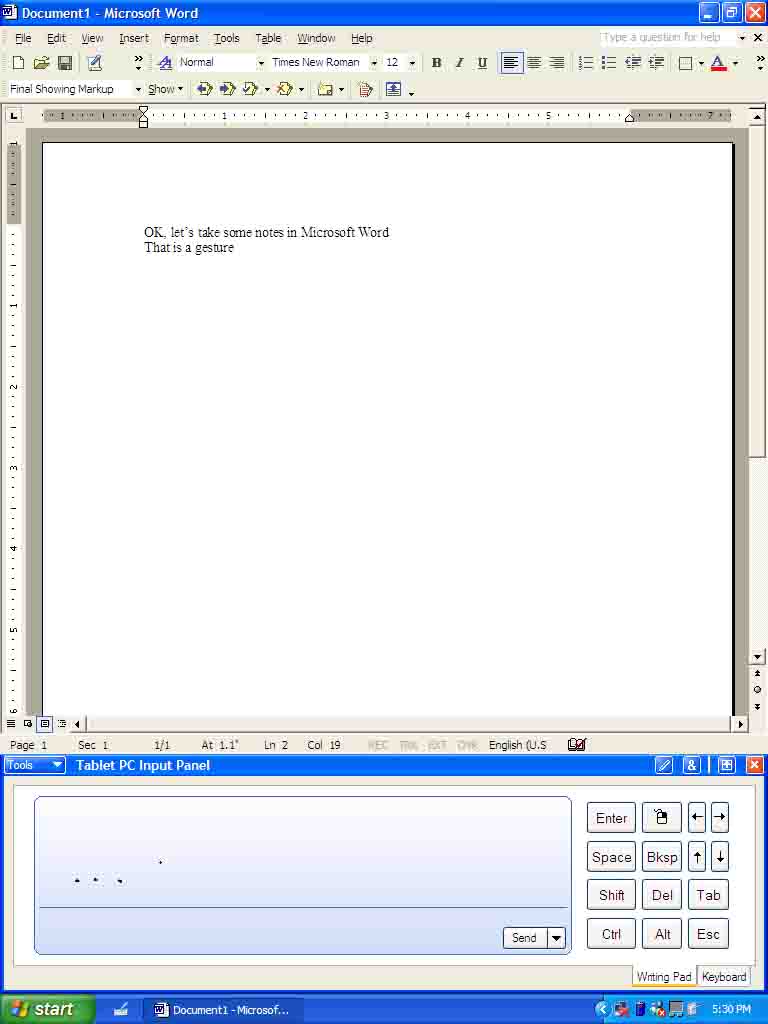
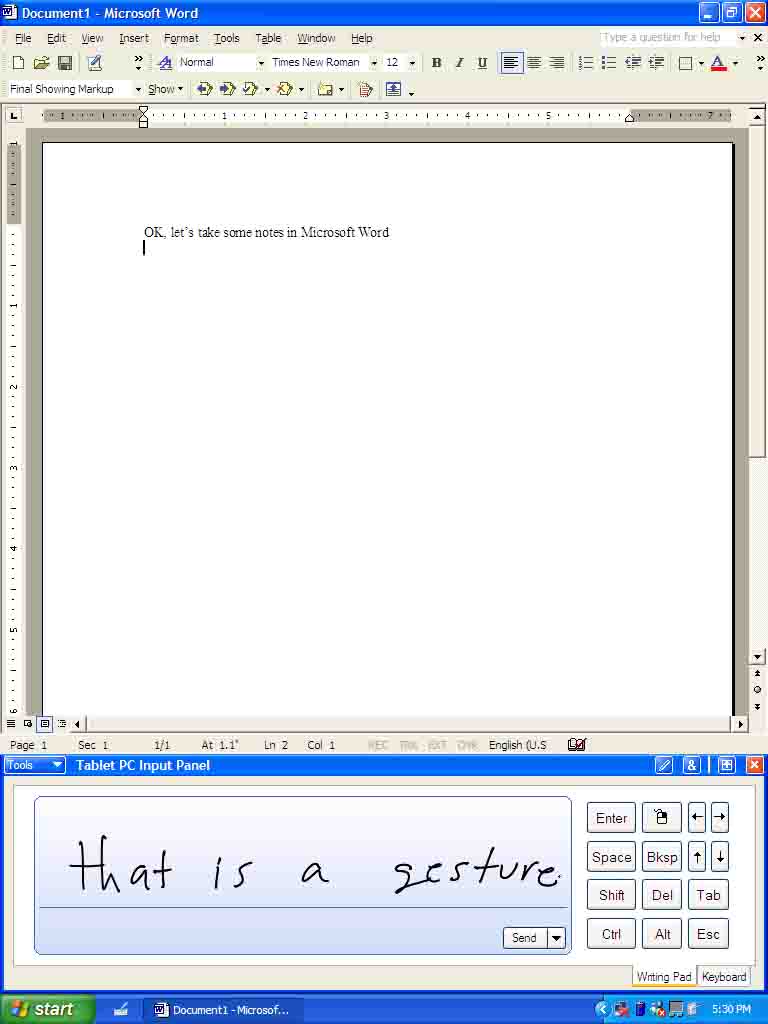
| #17 By 2459 (24.206.97.178) at Wednesday, June 26, 2002 12:13:03 PM |
|
Thanks for the images, Byron (and Paul).
This proves the recognition isn't cursive only. Still SJ's remaining question about ink portability and file size (though it's known that you can export to several formats). Paul also said that a viewer component is in the works. Sodajerk, you may want to keep tabs on http://www.tabletpcdeveloper.com and http://www.microsoft.com/tabletpc |
| #18 By 3339 (65.198.47.10) at Wednesday, June 26, 2002 12:47:50 PM |
| ...and don't forget the question I started with--does "ink" learn your writing charateristics as you go? |


